
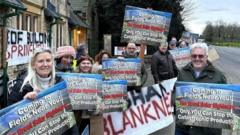
A potential judicial review is on the horizon regarding the government's recent approval of the Springwell Solar Farm, which is set to become the largest solar farm in the UK. This move is being considered by Lincolnshire County Council and North Kesteven District Council after the Department for Energy Security and Net Zero gave the green light for the project on April 8. According to BBC Lincolnshire, the government claims that this development will help "bring down bills for good," a sentiment that has sparked both interest and concern among local residents.
The proposed solar farm, developed by EDF, would cover an impressive area of 1,280 hectares—equivalent to 1,700 football pitches. It is designed to include a battery storage facility capable of powering approximately 180,000 homes. However, the approval has not come without controversy. Many local campaigners have voiced their worries about the potential loss of valuable farmland, the impact on the picturesque landscape, and the safety concerns surrounding the lithium-ion batteries that would be used in the project.
Both the Lincolnshire County Council and North Kesteven District Council expressed objections during the planning process, arguing that the proposals did not adequately assess the impacts on rural communities, the landscape, and agricultural land. A spokesperson for the councils stated, "Having carefully reviewed the examining authority's report and secretary of state's decision letter, the councils are concerned that the proper process was not followed and are now seeking to challenge the decision legally."
Sean Matthews, the leader of the county council, emphasized the importance of this challenge, saying, "Following legal advice and a careful consideration of the potential costs and impact, we believe we may have grounds to challenge this decision." Richard Wright, the leader of North Kesteven District Council, echoed these sentiments, describing the government’s decision-making process as "flawed."
The Local Democracy Reporting Service highlighted that the judicial review would be jointly funded by both councils, with potential costs reaching up to £500,000 if they were to lose the case. This financial commitment reflects the seriousness of their concerns and the desire to protect local interests.
Backing the councils in this endeavor is Conservative MP for Sleaford and North Hykeham, Dr. Caroline Johnson. She has made it clear that her constituents are opposed to large-scale ground-mounted solar farms, fearing they would disrupt the countryside and threaten food security.
As the situation develops, local residents are encouraged to stay informed and engage in discussions about the future of their landscape and community. The outcome of this judicial review could have significant implications for the region, and many are eager to see how it unfolds.